Income Basics · 5 min read

What Are Dividends?

Understand cash distributions, dividend yield, and why the highest yield is not always the best choice.

What Are Dividends?

Dividends are cash payments distributed by some companies to shareholders. For many investors, they represent income. But the quality and sustainability of that income matters more than the headline number alone.

How dividends work

A company decides whether to distribute part of its profits. If approved, shareholders eligible on the record date receive the dividend based on the number of shares they own.

  • Dividends come from distributable profits.
  • Approval dates matter.
  • Share count determines payout.
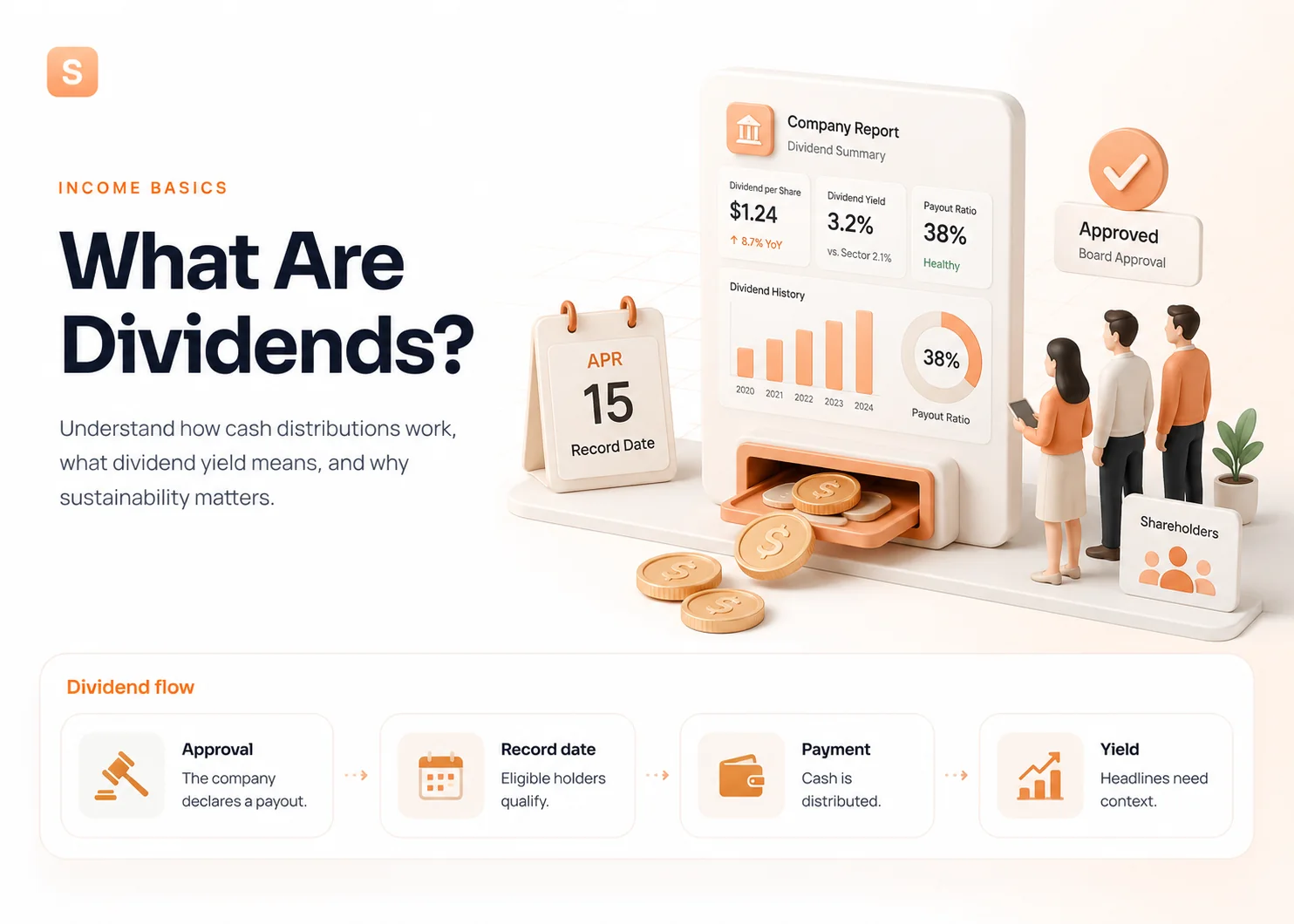
Dividend flow illustration from company approval and record date to shareholder payment and yield
A dividend passes from company approval to eligibility and payment; sustainable yield matters more than a headline number.

What dividend yield means

Dividend yield compares the annual cash dividend to the current share price. It can help compare income potential, but yield alone can be misleading if the business is weakening or the payout is unsustainable.

  • Yield links dividend to price.
  • High yield is not always good.
  • Sustainability matters.

What to examine beyond yield

Look at payout ratios, earnings stability, cash flow, debt, and business quality. A lower but more sustainable dividend can be stronger than an eye-catching yield that later disappears.

  • Review payout discipline.
  • Check earnings and cash flow.
  • Prefer durability over headlines.

Put it into practice — explore Egyptian mutual funds or ask the AI analyst.

Frequently asked questions

What is a dividend?
A dividend is a share of a company’s profits paid out to shareholders, usually in cash. Not all companies pay dividends — some reinvest profits for growth instead — and the amount is decided by the company’s board and general assembly.
How are dividends paid on the EGX?
An EGX-listed company announces a dividend, an ex-dividend date and a payment date. You must own the shares before the ex-dividend date to receive that payout; the cash is then credited to eligible shareholders on the payment date.
What is the ex-dividend date?
The ex-dividend date is the first day a share trades without the right to the declared dividend. To receive the dividend you must hold the shares before this date — buy on or after it and the seller keeps the payout.
What is dividend yield?
Dividend yield is the annual dividend per share divided by the current share price, shown as a percentage. It tells you the cash income you earn for each pound invested at today’s price, but a very high yield can also signal a falling price or an unsustainable payout.

Continue learning

All learn topics →