Compare the main fund families and understand when each one usually fits best.
Not all funds behave the same way. Some aim for growth, some prioritize stability, and others focus on liquidity. Understanding the category helps you set realistic expectations.
Equity funds
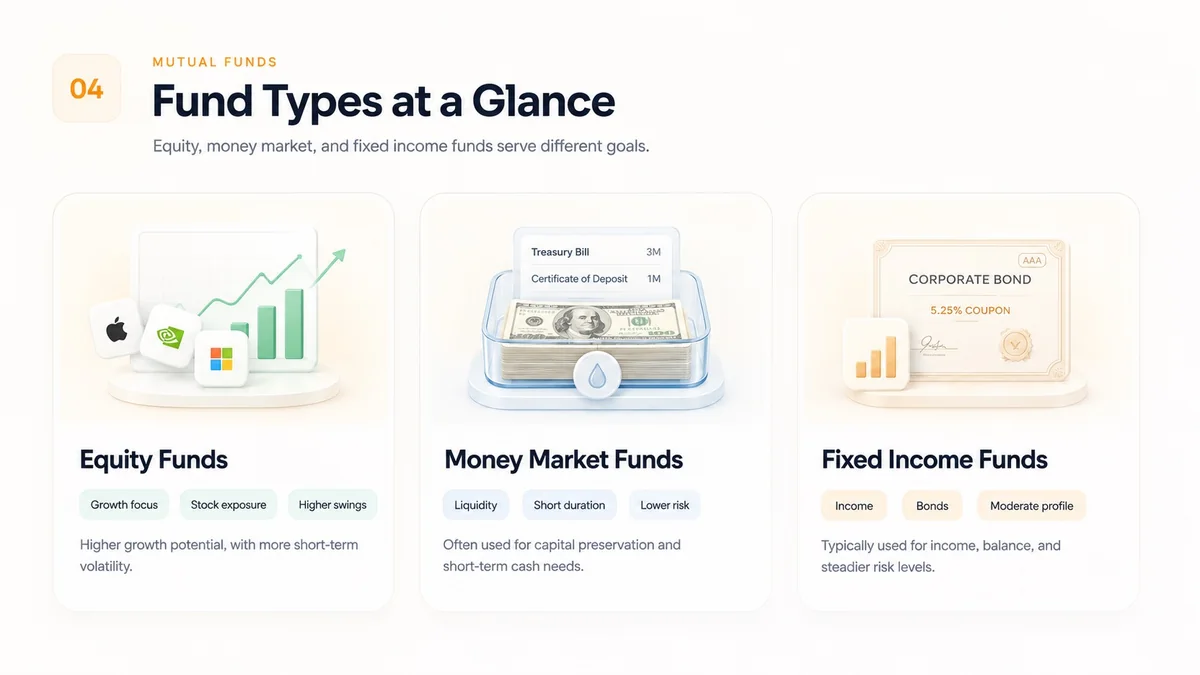
Equity funds invest mainly in stocks and are usually used when investors want long-term growth. They can offer stronger upside, but they also come with higher short-term swings.
Higher growth potential.
Higher volatility.
Often better for longer horizons.
Each fund category serves a different goal, from long-term growth to liquidity and steadier income.
Money market funds
Money market funds usually invest in short-duration, lower-risk instruments. They often suit investors who want liquidity, capital preservation, or a parking place for cash.
Liquidity focus.
Lower risk profile.
Often used for short-term cash management.
The right fund type depends on what matters most to you: growth, liquidity, income, and how long you plan to stay invested.
Fixed income funds
Fixed income funds sit between pure growth and pure liquidity for many investors. They often focus on bonds or income-generating instruments and may suit moderate risk profiles.
The common types are equity funds (mostly stocks), fixed-income funds (bonds and treasury bills), money-market funds (short-term, low-risk instruments), and balanced funds that mix stocks and bonds. Each sits at a different point on the risk-and-return scale.
What is a money market fund?
A money market fund invests in short-term, low-risk instruments such as treasury bills and bank deposits. It aims for capital preservation and steady, modest returns, which makes it one of the lowest-risk fund categories in Egypt.
What is the difference between equity and fixed-income funds?
Equity funds invest mainly in shares and target higher long-term growth with higher volatility. Fixed-income funds invest in bonds and treasury bills, aiming for steadier income and lower risk, usually with lower expected returns.
Which fund type is the least risky?
Money-market funds are generally the least risky, followed by fixed-income funds, then balanced funds, with equity funds carrying the most risk and the highest return potential.